Picking a true-sounding statement over the one that answers the question
Q3, Q9, Q14: each choice restates the passage, none answers the stem.
Fix
Restate the question in your own words before you look at the choices.
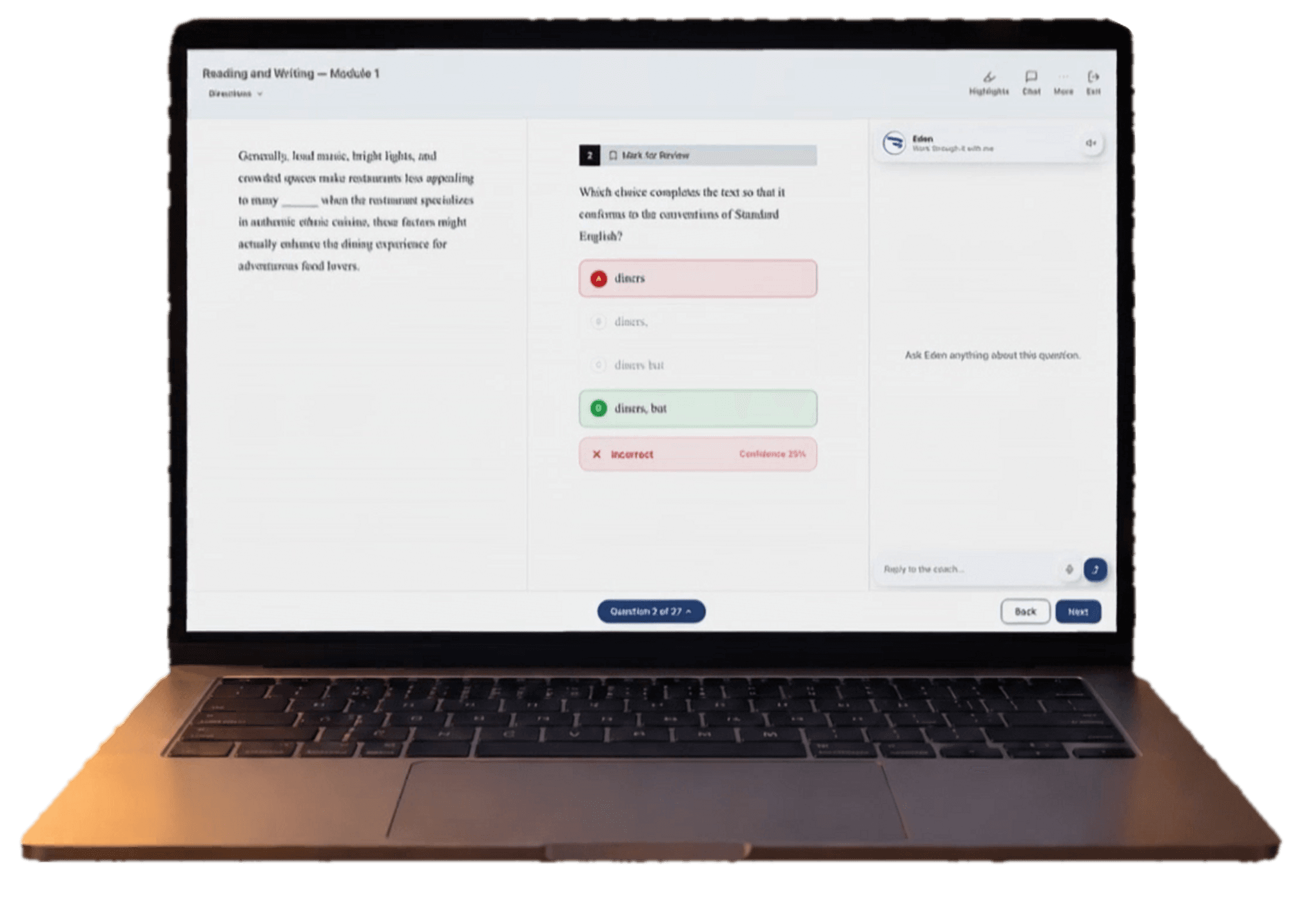
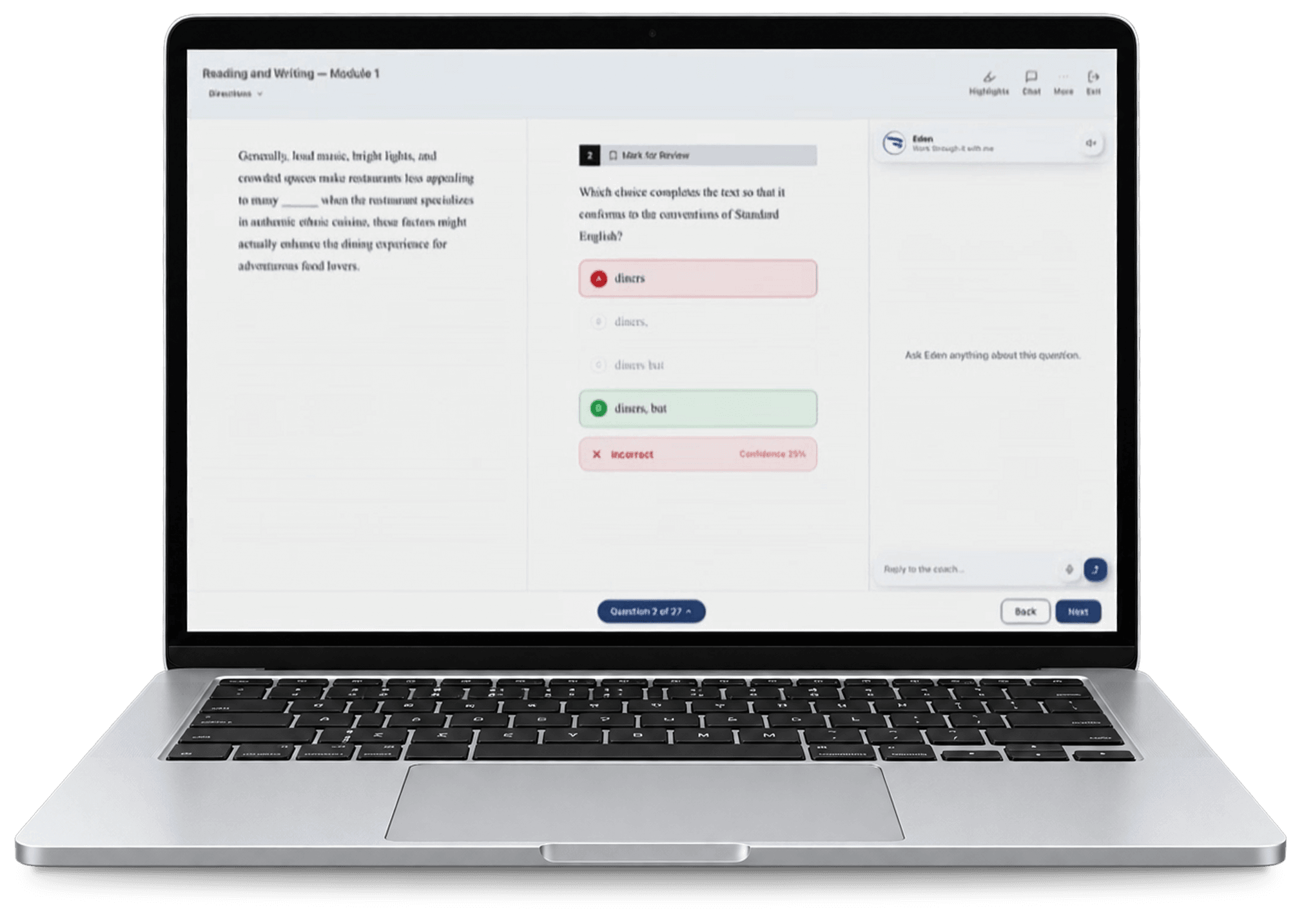
Which choice completes the text so that it conforms to the conventions of Standard English?
The line y = 2x + 1 meets the parabola y = x² − 2 at two points. What is the sum of their x-coordinates?

[2026 Sep #01] SuperfastSAT Full-Length Test
01
The read
Module 1 went well in both sections. The drop came in R&W Module 2, and it wasn’t vocabulary: you kept choosing answers that were true to the passage but didn’t answer the question.
02
The pattern
Picking a true-sounding statement over the one that answers the question
Q3, Q9, Q14: each choice restates the passage, none answers the stem.
Fix
Restate the question in your own words before you look at the choices.
03
The upside
What fixing this is worth
3 or 4 more right in R&W Module 2
Based on the misses that share this pattern.
Now go and see it
Walk the test with Eden, question by question.
Review with Eden →Multiple choice
Which definition matches candid?
You went with the candid-camera read — “caught off guard.” Almost everyone does.
But that describes the photo, not the word. Candid is about how someone speaks: frank and honest, even when it stings.
“To be candid, the essay needs a new ending,” her teacher said.
candid — pick the correct meaning
That one’s yours now.
Got it — continue →
You finished the [2026 Sep #01] Full-Length Test last night — Math Module 2 is where 7 of your 9 misses were. Want to start there?
Ask Eden about your SAT prep
↑Suggested ideas
Just tell me where to start
One thing to open now, and why that one
Find my weak spotEden suggests
The domains and skills where the misses cluster
Score me right now
If the test were today - from your most recent full module
Plan my week
A week of study around what's open
Recent
💬 Why did I miss Q14?
💬 Words for the week
💬 Is 1400 realistic by Oct?
yeah, what happened in module 2?
› Reasoning · Looked at where your misses cluster
Five of the seven were nonlinear functions— you set the equation up right, then solved for the wrong variable. You got them in Module 1, so it’s a habit under time pressure, not a gap. Twenty minutes on that chapter should fix it.
Reply to Eden
↑
Best Traction award

Best AI Tutor finalist
It brackets the clauses, labels the subject and verb, and marks the spot that decides it.
It opens Desmos and graphs the problem, so you see the answer instead of guessing it.
Not a wall of numbers. What went wrong, why it keeps happening, and what to fix first.
Eden explains why your guess felt right, what the word really means, then checks you've got it.
Open the app and Eden already knows where you left off, and what to do next.

Variant 1 of 12
Words in Context
Reading and Writing · Medium
Full-Length Test
98 questions
Both sections · 2h 14m
Variant 4 of 9
Nonlinear functions
Math · Hard
Module Test
Math · Module 2
22 questions · 35m
Variant 7 of 12
Boundaries
Reading and Writing · Hard
Section Test
Reading and Writing
54 questions · 64m
Variant 2 of 8
Circles
Math · Medium
Diagnostic
Where you stand
Both sections · 40m
Variant 11 of 15
Transitions
Reading and Writing · Easy
Hard Module Drill
Adaptive Module 2
27 questions · 32m
Module Test
Math · Module 2
22 questions · 35m
Variant 7 of 12
Boundaries
Reading and Writing · Hard
Section Test
Reading and Writing
54 questions · 64m
Variant 2 of 8
Circles
Math · Medium
Diagnostic
Where you stand
Both sections · 40m
Variant 11 of 15
Transitions
Reading and Writing · Easy
Hard Module Drill
Adaptive Module 2
27 questions · 32m
Variant 1 of 12
Words in Context
Reading and Writing · Medium
Full-Length Test
98 questions
Both sections · 2h 14m
Variant 4 of 9
Nonlinear functions
Math · Hard
Variant 2 of 8
Circles
Math · Medium
Diagnostic
Where you stand
Both sections · 40m
Variant 11 of 15
Transitions
Reading and Writing · Easy
Hard Module Drill
Adaptive Module 2
27 questions · 32m
Variant 1 of 12
Words in Context
Reading and Writing · Medium
Full-Length Test
98 questions
Both sections · 2h 14m
Variant 4 of 9
Nonlinear functions
Math · Hard
Module Test
Math · Module 2
22 questions · 35m
Variant 7 of 12
Boundaries
Reading and Writing · Hard
Section Test
Reading and Writing
54 questions · 64m
Variant 11 of 15
Transitions
Reading and Writing · Easy
Hard Module Drill
Adaptive Module 2
27 questions · 32m
Variant 1 of 12
Words in Context
Reading and Writing · Medium
Full-Length Test
98 questions
Both sections · 2h 14m
Variant 4 of 9
Nonlinear functions
Math · Hard
Module Test
Math · Module 2
22 questions · 35m
Variant 7 of 12
Boundaries
Reading and Writing · Hard
Section Test
Reading and Writing
54 questions · 64m
Variant 2 of 8
Circles
Math · Medium
Diagnostic
Where you stand
Both sections · 40m
Which choice most logically completes the text?
Every domain and difficulty, plus full-length SAT tests whenever you're ready.
Browse questionsEvery answer feeds Eden's engine. It finds where your misses cluster and tells you what to open next.
Meet EdenBuilt by SAT specialists and updated as soon as the test changes, so you practise what's on it.
See the coursesSame timing, same tools, same Desmos and reference sheet. Test day feels like practice.
Try a test